


India is going through one of its biggest labour reforms in decades. The government has introduced four new labour codes that replace 29 older central labour laws. The idea is straightforward; instead of different rules for different sectors and situations, the country now moves toward a cleaner and more organised labour framework.
For HR teams and employers, these reforms are important as they affect wages, contracts, hiring, social security and the way workplaces manage employees. For workers, the new codes promise more protection, more clarity and better access to benefits.
Why Were These Reforms Needed?
For many years, India followed several separate labour laws that developed at different times and for different purposes. Over time, they became difficult to follow and often overlapped. Employers struggled with compliance, and employees struggled with inconsistent protections.
The new labour codes simplify this structure. They cover wages, industrial relations, social security and occupational safety in a unified way. This allows organisations to work with more clarity and gives workers a stronger foundation of rights.
What Has Improved Under the New Labour Codes?
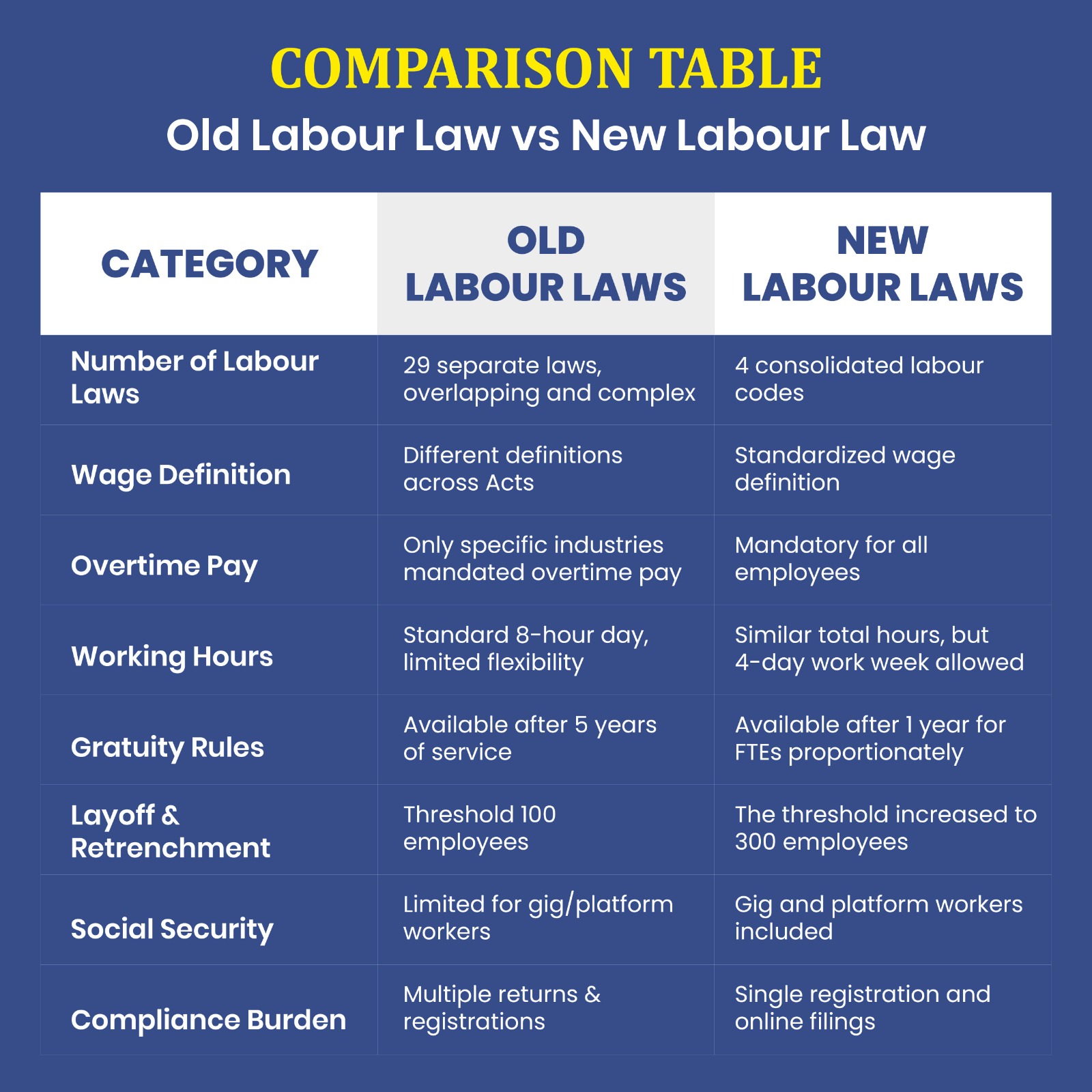
The new labour codes bring more clarity, wider coverage and better protection for employees while also simplifying compliance for organizations. Earlier, employers had to interpret several different definitions, rules and procedures. Now, with a unified structure, HR teams can manage wages, social security, contracts and workplace requirements with far more consistency. Workers also benefit from stronger rights, timely wages and access to social security that was previously unavailable to many categories of employees.
Key Improvements:
- A single and consistent definition of wages used for PF, gratuity, overtime and leave calculations
- Minimum wages apply to every worker across all sectors
- Mandatory timely wage payment through transparent channels
- Social security benefits extended to gig workers, platform workers, contract staff and informal workers
- Gratuity eligibility improved for fixed-term employees based on contract duration
- Mandatory appointment letters for every employee to ensure clarity in roles and terms
- Simpler compliance through a single licence and a single electronic return
- One structured system for safety, health and working conditions for all workplaces
What This Means for HR and Employers?
The shift to a uniform wage definition means companies may need to review salary structures to ensure they align with the law. An allowance-heavy CTC structure may need adjustments because statutory benefits are now tied to the standard wage definition.
Since appointment letters are compulsory, HR teams should review and standardize all employment documentation. Policies related to leave, attendance, overtime, safety and working conditions may also require updates.
Organisations that employ gig or contract workers should extend social security coverage and revise onboarding processes. The simplified compliance system is an opportunity to move toward digital records and streamlined filings.
What Changes for Employees?
Workers can expect more stability and fairness. Timely wage payments become a right. Minimum wage protection is available to everyone. More people, especially gig and contract workers, receive social security coverage. Workplaces are required to follow uniform health and safety standards. Most importantly, every worker gets a proper appointment letter that explains their role and terms of employment.
Possible Challenges Ahead
The transition may bring some challenges. Salary structures may need rebalancing, which could affect the in-hand salary for certain employees. Social security compliance may create additional administrative work at the beginning, especially for organisations that rely heavily on contract or gig staff. Smaller companies may need support to adopt digital compliance processes. There may also be differences between states until all states fully adopt and notify the codes.
Conclusion
India’s new labour codes represent a major step toward fairness, clarity and modern workplace governance. They simplify life for employers and provide stronger protection for employees across both formal and informal sectors.
For HR teams, this is the right time to update policies, improve transparency and align internal systems with the new legal standards. The reform is an opportunity to create workplaces that are more organised, more secure and more respectful of employee rights.